401k Withdrawal Calculator
This calculator projects your 401(k) balance at retirement and the income it can pay. Starting at 45 with $500,000, adding $19,500 a year at a 7% return, you'd have about $2,870,000 at 65; 4% of that is about $9,550 a month before taxes.
How the calculation works
Before retirement, your balance grows monthly at your expected return, with your yearly contribution added in twelve parts. At retirement, your yearly withdrawal is your withdrawal rate times that balance. Monthly income adds Social Security and any other income you enter.
Withdrawals from a traditional 401(k) are taxed as ordinary income, so the calculator shows taxes at the bracket you choose. From 73 (75 if you were born in 1960 or later), required minimum distributions apply.
Example
Age 45, $500,000 saved, $19,500 a year, 7% return, retiring at 65: about $2,870,000. A 4% first-year withdrawal is about $114,600 a year, or $9,550 a month before taxes.
What it leaves out
Employer matches, contribution limits and early-withdrawal penalties aren't modeled; returns are steady. To see how long a balance lasts once you start withdrawing, use the How Long Will My Money Last calculator.
Frequently Asked Questions
When should I start taking withdrawals from my 401(k)?
For most people, it's best to wait until at least age 59½ to avoid the 10% early withdrawal penalty. However, if you retire earlier, there are exceptions like the Rule of 55 that might help you access funds penalty-free. On the flip side, you must start Required Minimum Distributions (RMDs) by age 73 (or 75 if you were born after 1960) to avoid hefty penalties. Our free calculator helps you model different withdrawal start dates to find your optimal strategy.
What's the 4% rule, and is it still valid?
The 4% rule suggests withdrawing 4% of your retirement savings in your first year of retirement, then adjusting that amount for inflation each subsequent year. While it was once considered the gold standard for sustainable withdrawals, today's financial experts have mixed opinions on its current validity. Lower expected market returns and longer lifespans have led some to recommend a more conservative 3-3.5% withdrawal rate. Others suggest dynamic withdrawal strategies that adjust based on market conditions. Our free calculator allows you to test different withdrawal rates and strategies to find what works best for your situation.
How are 401(k) withdrawals taxed?
Traditional 401(k) withdrawals are taxed as ordinary income—just like your paycheck was during your working years. This means federal income tax, plus state and local taxes where applicable. If you're under 59½, you'll typically face an additional 10% early withdrawal penalty. Roth 401(k) withdrawals, however, can be tax-free if you've held the account for at least 5 years and are over 59½. Our free calculator factors in your expected tax bracket to show you what you'll actually take home after taxes.
What are Required Minimum Distributions (RMDs) and how do they affect my withdrawal strategy?
RMDs are the minimum amounts you must withdraw from your traditional 401(k) and IRA accounts annually, starting at age 73 (or 75 if born after 1960). The exact amount is calculated based on your account balance and life expectancy, and it increases as you age. Failure to take your RMD results in a hefty 25% tax penalty on the amount not withdrawn. Our free calculator automatically factors in RMDs when projecting your long-term withdrawal strategy, ensuring your plan stays on the right side of IRS regulations.
Should I roll my 401(k) into an IRA when I retire?
It depends on your specific situation. IRAs often offer more investment options and potentially lower fees than 401(k)s. However, 401(k)s have some unique advantages: better creditor protection in some states, the ability to withdraw penalty-free if you retire at 55 or later (versus 59½ for IRAs), and the option to delay RMDs if you're still working. Some people choose a partial rollover strategy, keeping some funds in each account type. Our free calculator can help you understand the implications of different withdrawal strategies regardless of account type.
How should I adjust my withdrawals during market downturns?
Market downturns early in retirement can significantly impact your portfolio's long-term sustainability—this is called sequence of returns risk. During these periods, many financial advisors recommend temporarily reducing withdrawals if possible, taking proportionally more from cash/bond allocations while giving equities time to recover, or supplementing with part-time work. Our free calculator's stress testing feature can simulate how market downturns might affect your plan and help you develop appropriate contingency strategies.
What withdrawal strategy is best for minimizing taxes in retirement?
Tax-efficient withdrawal strategies typically involve careful coordination between different account types (traditional, Roth, taxable) and considering your tax bracket each year. Many experts recommend a strategy that aims to smooth your taxable income over your retirement years. This might include taking traditional 401(k) withdrawals up to the top of your desired tax bracket, then supplementing with tax-free Roth withdrawals. Some retirees benefit from doing strategic Roth conversions during low-income years. Our free calculator helps you visualize your withdrawals and potential tax impacts over time.
How do I factor Social Security into my withdrawal strategy?
Social Security should be viewed as a foundational piece of your retirement income plan. When you claim benefits significantly impacts both your monthly check amount and how much you'll need to withdraw from your retirement accounts. Generally, delaying Social Security increases your benefit amount by about 8% per year from full retirement age until age 70, which can reduce pressure on your portfolio. Our free calculator allows you to input your expected Social Security benefits and see how different claiming strategies affect your overall retirement income plan.
What's the best way to make my money last my entire lifetime?
The key to making your money last is adopting a flexible withdrawal strategy that adapts to both market conditions and your changing needs. This typically involves: maintaining a diversified portfolio appropriate for your age and risk tolerance, not withdrawing too much in the early years of retirement (especially during market downturns), regularly reviewing and adjusting your withdrawal rate based on portfolio performance, and considering products like qualified longevity annuities for longevity protection. Our free calculator helps you stress-test your plan against scenarios like living longer than expected or facing poor market returns.
How accurate is this 401(k) withdrawal calculator?
Our free calculator uses industry-standard formulas and realistic assumptions to model retirement scenarios. However, no calculator can predict the future with perfect accuracy. Market returns will fluctuate, tax laws will change, and personal circumstances evolve. The real value of our calculator isn't in predicting exact dollar amounts 30 years from now—it's in helping you understand how different withdrawal strategies and scenarios might affect your retirement outcome. We recommend using this free tool to identify potential issues, test different approaches, and regularly revisit your plan as your situation changes.
Related Calculators
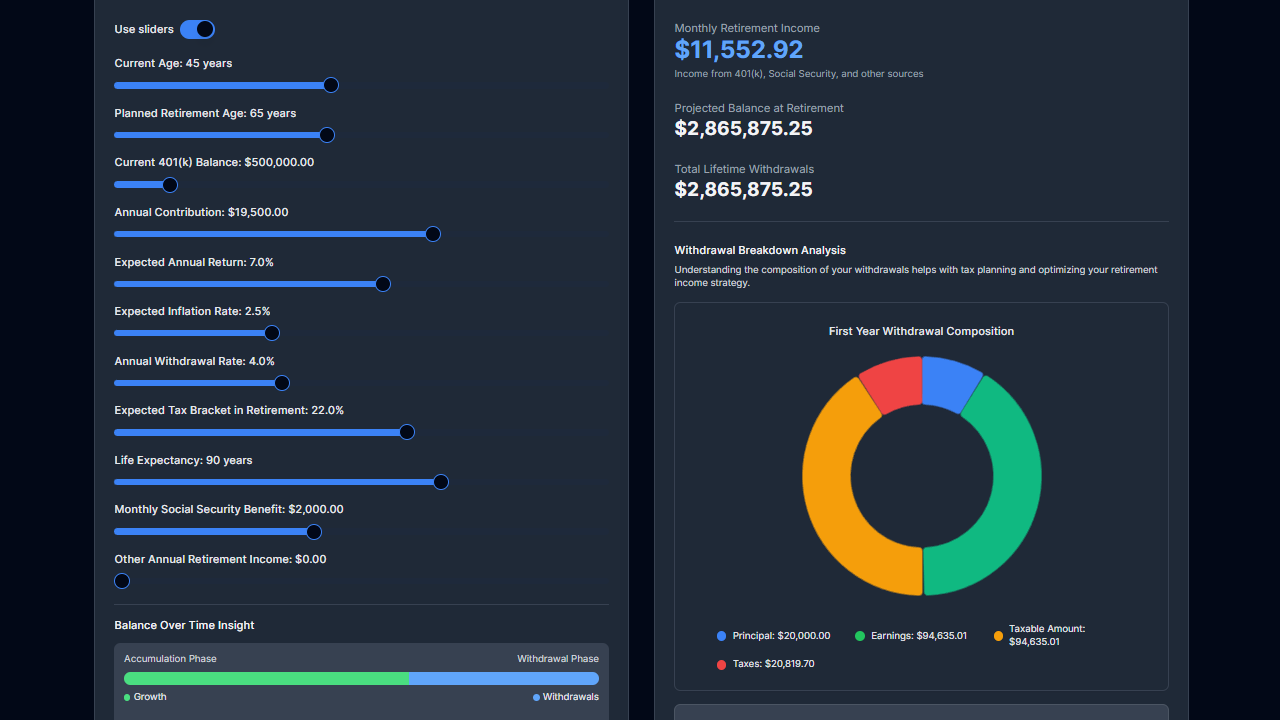
401k Withdrawal Calculator in Dark Mode
Optimize your 401k withdrawals with our dark-themed calculator. Plan your retirement income strategy.
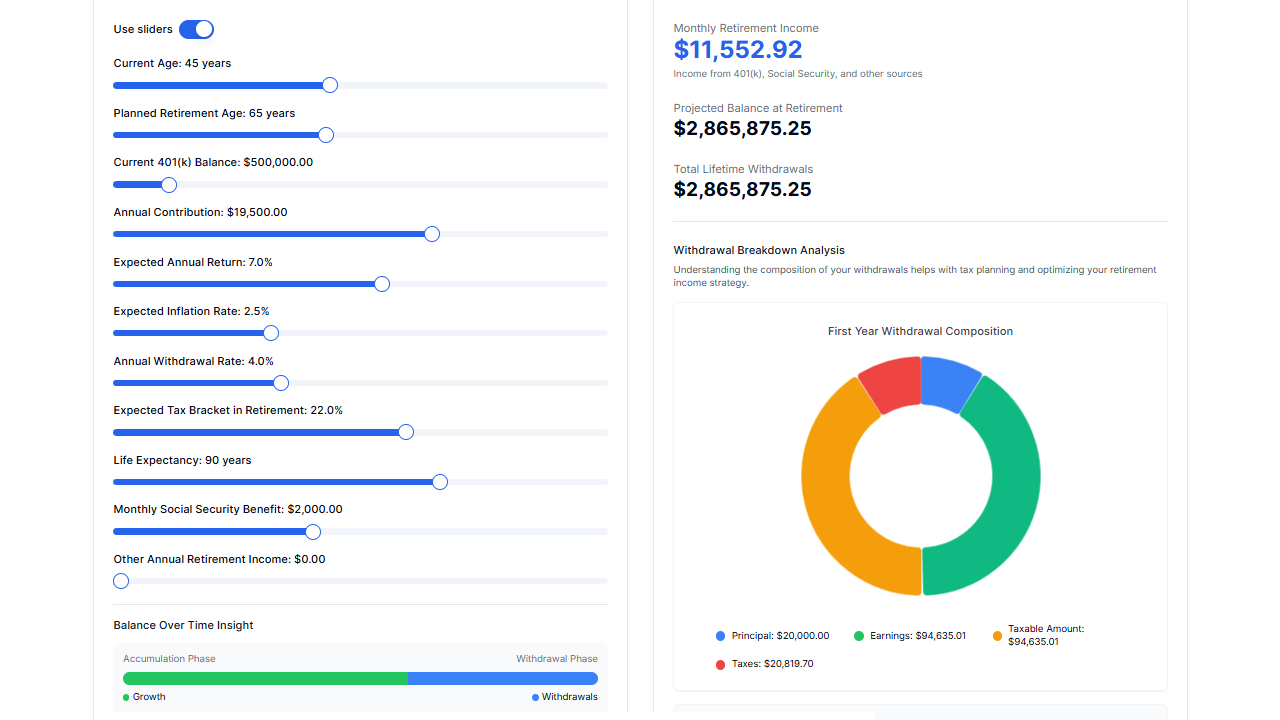
401k Withdrawal Calculator in Light Mode
Calculate optimal 401k withdrawal strategies with our calculator. Maximize your retirement income.