Required Minimum Distribution Calculator
Calculate your required minimum distributions (RMDs) from retirement accounts based on age, account balance, and IRS life expectancy tables
About the Required Minimum Distribution Calculator
Our free required minimum distribution calculator helps you quickly and accurately perform required minimum distribution calculations online. This tool is designed to be easy to use and provides instant results without requiring any signup or registration.
How to Use This Calculator
Simply enter your values in the input fields above, and the calculator will automatically process your data and display the results. You can adjust your inputs at any time to see how they affect the outcome.
Why Choose Our Required Minimum Distribution Calculator
- Completely free to use with no hidden fees
- No registration or account creation required
- Accurate calculations based on industry-standard formulas
- User-friendly interface designed for ease of use
- Works on all devices including desktops, tablets, and smartphones
Frequently Asked Questions
What exactly is a Required Minimum Distribution (RMD)?
A Required Minimum Distribution is the minimum amount you must withdraw annually from your tax-advantaged retirement accounts once you reach a certain age (currently 73 for individuals born between 1951 and 1959, and 75 for those born in 1960 or later). These mandatory withdrawals apply to traditional IRAs, 401(k)s, 403(b)s, and most other retirement accounts except Roth IRAs during the original owner's lifetime.
When do I need to start taking RMDs?
For those born between 1951 and 1959, you must start taking RMDs at age 73. If you were born in 1960 or later, RMDs begin at age 75. Your first RMD must be taken by April 1 of the year following the year you reach the required age. For subsequent years, RMDs must be taken by December 31. Note that waiting until April 1 of the following year for your first RMD means you'll take two distributions in that calendar year, which could impact your tax situation.
How are RMDs calculated?
RMDs are calculated by dividing your retirement account balance (as of December 31 of the previous year) by a distribution period based on your age. The IRS provides life expectancy tables in Publication 590-B. Most people use the Uniform Lifetime Table, but if your spouse is the sole beneficiary and is more than 10 years younger than you, you can use the Joint Life and Last Survivor Expectancy Table, which might reduce your required distribution.
What happens if I don't take my RMD?
The penalty for not taking your full RMD is significant. As of 2023, the penalty is 25% of the amount not withdrawn (reduced to 10% if corrected promptly). This is a substantial decrease from the previous 50% penalty, but it remains one of the most severe penalties in the tax code. The IRS can waive this penalty if you can demonstrate that the shortfall was due to reasonable error and you're taking steps to remedy it.
Do I have to take an RMD if I'm still working?
If you're still working beyond the required age for RMDs, you may be able to delay taking RMDs from your current employer's retirement plan (not including SEP or SIMPLE IRAs) until April 1 of the year following your retirement. However, this exception only applies if your retirement plan permits it and you don't own more than 5% of the company. Regardless of your employment status, you still must take RMDs from other retirement accounts like Traditional IRAs or previous employers' plans.
Can I convert my Traditional IRA to a Roth IRA to avoid RMDs?
Yes, you can convert some or all of your Traditional IRA funds to a Roth IRA to avoid future RMDs, since Roth IRAs don't require distributions during the owner's lifetime. However, the conversion is a taxable event—you'll pay income tax on the converted amount in the year of conversion. This strategy makes the most sense if you believe you'll be in a higher tax bracket during retirement or want to leave tax-free assets to your heirs.
Can I take more than the required minimum distribution?
The 'M' in RMD stands for 'Minimum'—there's no maximum limit. You can withdraw as much as you want from your retirement accounts. However, remember that these withdrawals are generally taxable as ordinary income (except for any after-tax contributions you made), so taking significantly larger distributions could push you into a higher tax bracket.
How do RMDs affect my Social Security benefits?
RMDs count as income that may cause your Social Security benefits to become taxable. If your combined income (adjusted gross income + nontaxable interest + half of your Social Security benefits) exceeds certain thresholds, up to 85% of your benefits may be subject to income tax. Additionally, higher income from RMDs could increase your Medicare Part B and Part D premiums through Income-Related Monthly Adjustment Amounts (IRMAA).
Can I donate my RMD to charity to avoid taxes?
Yes, through what's called a Qualified Charitable Distribution (QCD). If you're at least 70½ years old, you can transfer up to $100,000 annually directly from your IRA to a qualified charity. This transfer counts toward your RMD requirement but is excluded from your taxable income—a win-win that satisfies your distribution requirement while supporting charitable causes. The funds must be transferred directly to the charity to qualify for this tax treatment.
Related Calculators
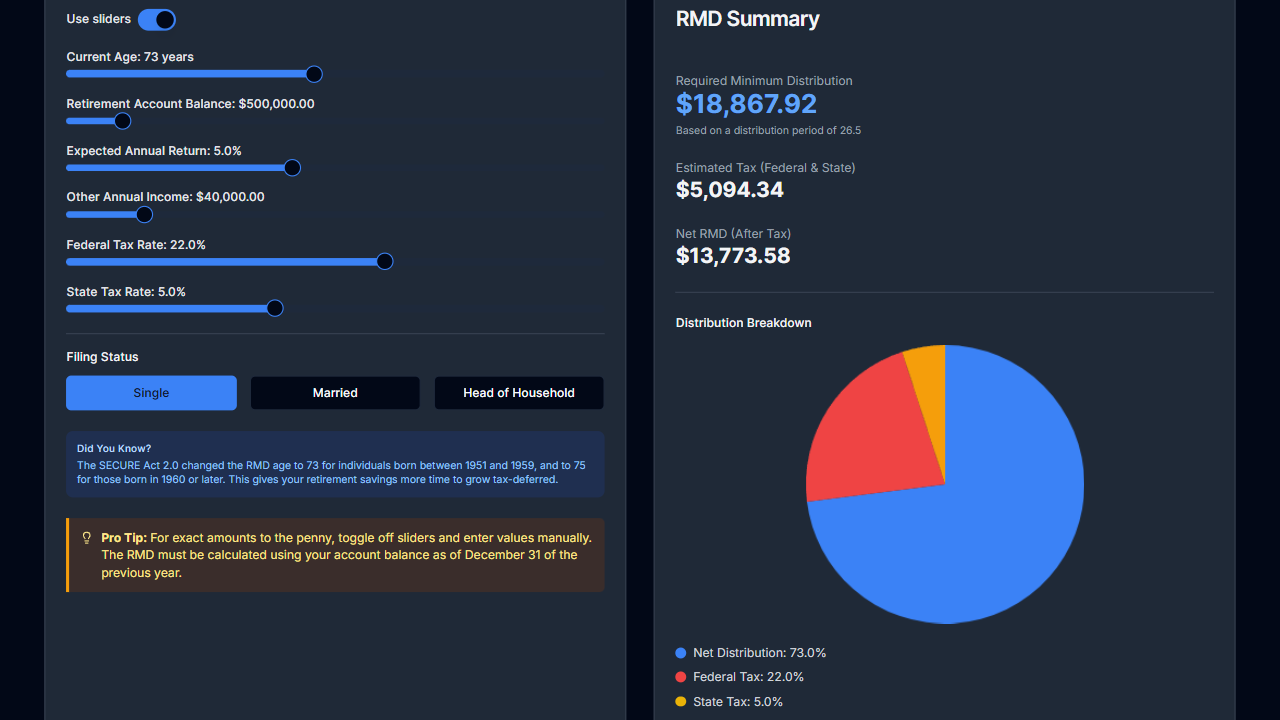
Required Minimum Distribution Calculator in Dark Mode
Calculate your RMDs with our dark-themed calculator. Stay compliant with IRS requirements.
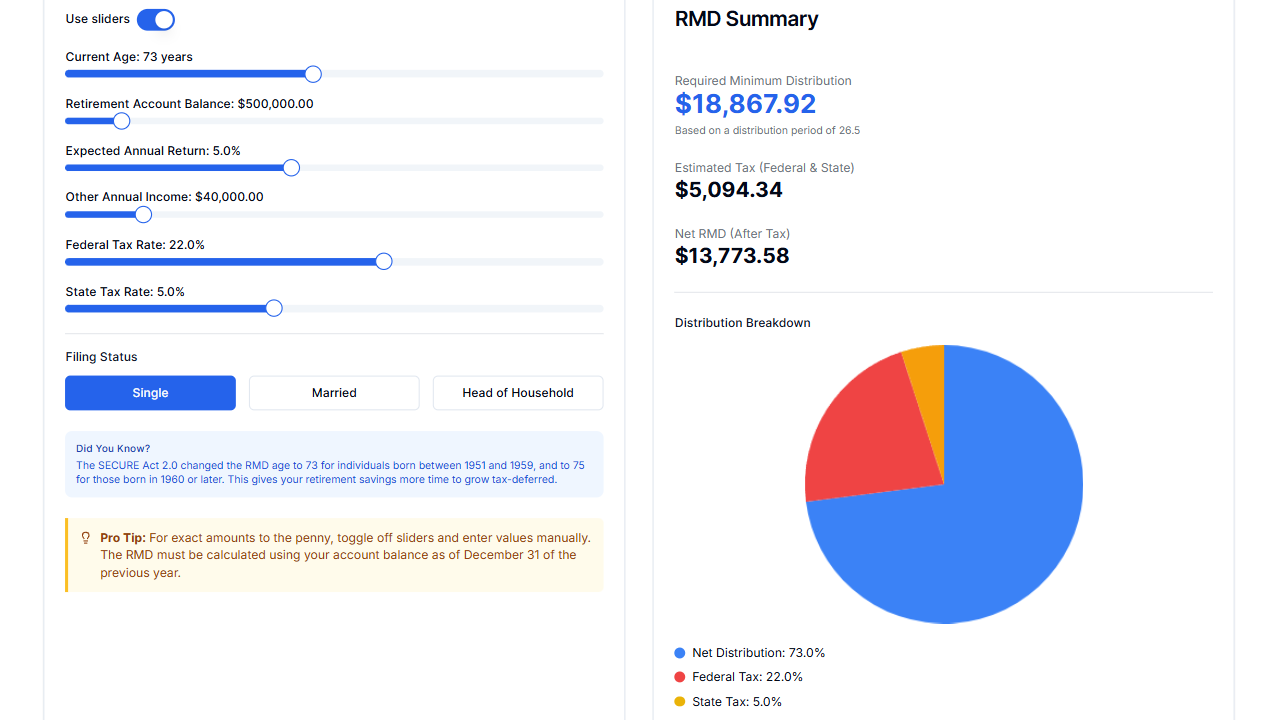
Required Minimum Distribution Calculator in Light Mode
Determine your required minimum distributions with our calculator. Plan your retirement withdrawals.