IRA Withdrawal Calculator
Calculate optimal IRA withdrawal strategies based on your portfolio size, estimated returns, inflation rates, and personal lifestyle preferences.
Frequently Asked Questions
What's the difference between Traditional, Roth, and Converted Roth IRAs?
Traditional IRAs are funded with pre-tax dollars and grow tax-deferred, but withdrawals are taxed as ordinary income. Roth IRAs are funded with after-tax dollars, grow tax-free, and qualified withdrawals are completely tax-free. Converted Roth IRAs started as Traditional IRA money that was converted to Roth status by paying taxes at the time of conversion, and then grow tax-free thereafter.
When do I have to take Required Minimum Distributions (RMDs)?
As of 2023, you must begin taking RMDs from Traditional IRAs at age 73. The required amount is calculated based on your account balance and your life expectancy using IRS tables. Importantly, Roth IRAs do NOT have RMDs during the owner's lifetime, which is a significant advantage for tax planning and estate purposes.
What is the 'Pro-Rata Rule' and how does it affect IRA withdrawals?
The Pro-Rata Rule applies when you have both pre-tax and after-tax money in Traditional IRAs. It prevents you from selectively withdrawing only the after-tax contributions. Instead, each withdrawal is treated as a proportional mix of pre-tax and after-tax money based on the ratio of after-tax contributions to the total balance across all your Traditional IRAs. This rule significantly impacts tax planning strategies like backdoor Roth conversions.
How does the 5-year rule work for Roth IRA withdrawals?
There are actually two 5-year rules for Roth IRAs. The first applies to earnings: to withdraw earnings tax-free, your first Roth contribution must have been made at least 5 years ago AND you must be 59½ or meet other qualifying conditions. The second applies to conversions: each conversion has its own 5-year waiting period before the converted principal can be withdrawn penalty-free if you're under 59½. These rules can get complex, especially with multiple conversions.
Why would I want to convert Traditional IRA money to a Roth IRA?
Roth conversions can be advantageous if: 1) You expect to be in a higher tax bracket in retirement, 2) You want to reduce future RMDs, 3) You have a long time horizon for the converted amount to grow tax-free, 4) You're in a temporarily low tax bracket year, or 5) You want to leave tax-free assets to your heirs. The key is paying tax now at a lower rate than you would pay later.
What withdrawal strategy minimizes taxes in retirement?
The optimal strategy depends on your specific situation, but generally: 1) Take RMDs as required, 2) Withdraw from taxable accounts first, 3) Then withdraw from Traditional IRAs up to the top of your desired tax bracket, 4) Use Roth IRA withdrawals to fill additional income needs. This 'bracket filling' approach can significantly reduce lifetime taxes. Our calculator helps you visualize and optimize this sequencing.
How does Social Security affect my IRA withdrawal strategy?
Social Security benefits can become taxable depending on your 'combined income' (adjusted gross income + nontaxable interest + half of your Social Security benefits). Up to 85% of benefits may be taxable if your combined income exceeds certain thresholds. This creates a complex tax planning puzzle where Traditional IRA withdrawals can increase the taxation of your Social Security benefits, making Roth withdrawals potentially more valuable.
Should I delay taking Social Security to maximize my benefits?
Delaying Social Security increases your benefit amount by approximately 8% per year from full retirement age until age 70. This guaranteed return can be attractive, especially for those with longevity in their family. If you need income during the delay period, you might strategically withdraw from your IRAs. The optimal strategy depends on your health, other income sources, expected longevity, and tax situation.
What happens to my IRA if I retire early?
If you retire before 59½, special rules apply. You may be able to access IRA funds penalty-free (though not tax-free for Traditional IRAs) through Substantially Equal Periodic Payments (SEPP) under Rule 72(t). For Roth IRAs, you can always withdraw your contributions (but not earnings) penalty-free and tax-free. Planning for early retirement requires careful sequencing of withdrawals across different account types to minimize taxes and penalties.
Related Calculators
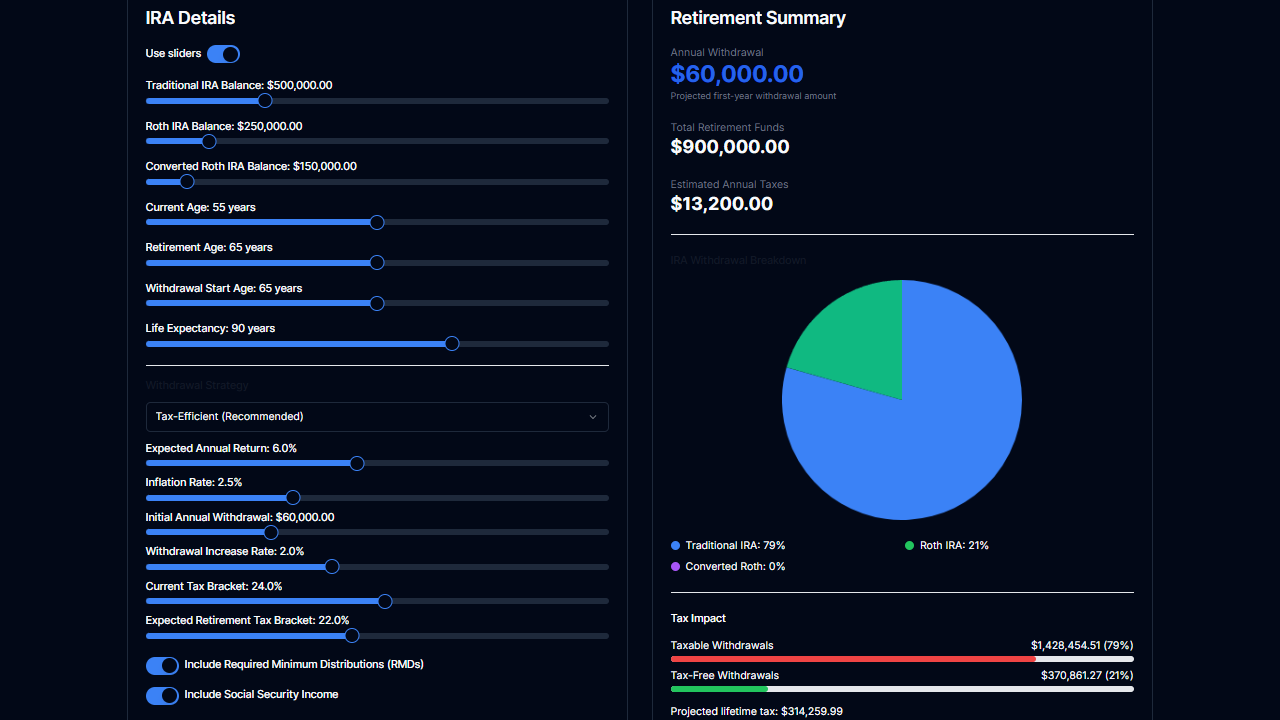
IRA Withdrawal Calculator in Dark Mode
Plan your IRA distribution strategy with our dark-themed calculator. Optimize your retirement income.
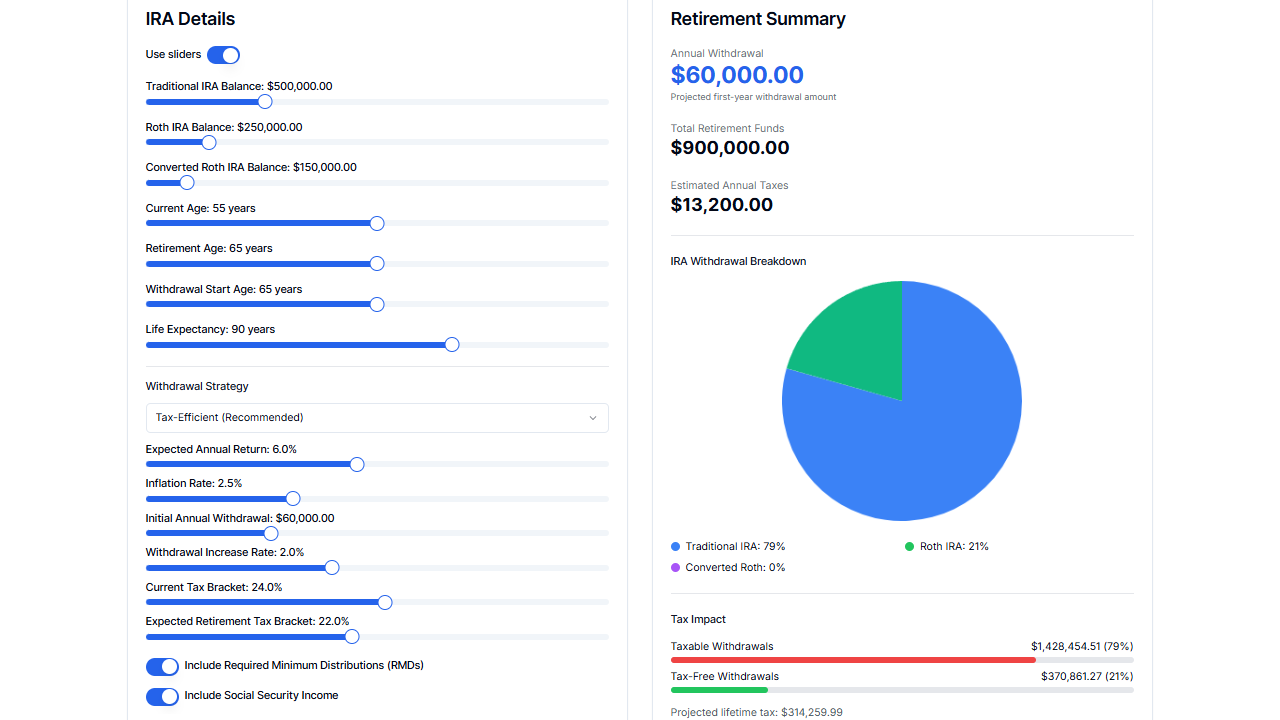
IRA Withdrawal Calculator in Light Mode
Calculate optimal IRA withdrawal strategies with our calculator. Plan your retirement distributions.