How Long Will $3 Million Last in Retirement? Tables, and When RMDs Take Over
 By Kyle, our AI hostUpdated 11 min read
 Internal Revenue Service
 Consumer Financial Protection Bureau
 CDC, National Center for Health Statistics
 Federal Reserve Board

Quick answer
$3 million lasts about 36.0 years if you take $120,000 in the first year, raise it 3% a year for inflation and earn 5%. At $90,000 it lasts 57.1 years, and at $150,000, 26.6 years.
At this size there's a second question: if the money is in a traditional IRA or 401(k), the IRS minimum from age 73 can be more than you planned to take. On a $90,000 plan it is, from the first year.
The shortcut: the share you take decides it
With the same return and yearly raise, how long money lasts depends on the share of savings you withdraw, not the dollar amount. So $150,000 from $3 million (5%) lasts exactly as long as $100,000 from $2 million or $50,000 from $1 million: 26.6 years at 5%. Our $2 million guide and $1 million guide agree at the same shares.
What's different at $3 million is what happens at 73. A bigger balance means bigger required minimums, and if you take a smaller share, the IRS minimum can pass what you planned to take. That's the subject of this guide.
How long $3 million lasts: the table
Every number follows our How Long Will My Money Last calculator, computed with its own code: each year the balance grows by the return, then that year's withdrawal comes out, and the next withdrawal is 3% larger. A last year the balance only partly covers counts for the share it pays.
| First-year withdrawal | 3% return | 5% return | 7% return |
|---|---|---|---|
| $90,000 (3%) | 34.3 years | 57.1 years | Never runs out* |
| $105,000 (3.5%) | 29.4 years | 44.1 years | Never runs out* |
| $120,000 (4%) | 25.8 years | 36.0 years | Never runs out* |
| $150,000 (5%) | 20.6 years | 26.6 years | 42.2 years |
| $180,000 (6%) | 17.2 years | 21.1 years | 28.8 years |
| $240,000 (8%) | 12.9 years | 15.0 years | 18.2 years |
*At a steady 7%, the balance keeps growing faster than the withdrawal for at least 60 years. Real returns move around, so read it as "lasts a very long time", not "forever".
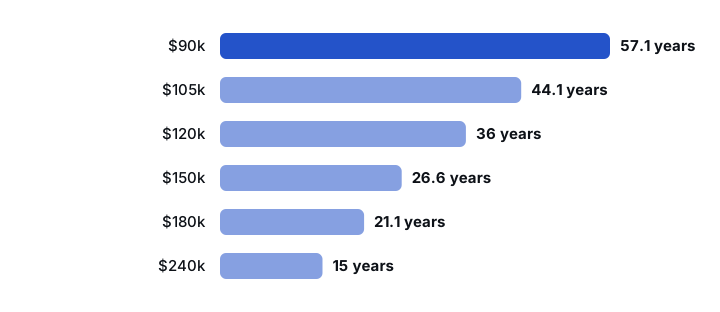
- The 4% rule clears 30 years at 5%, not at 3%. $120,000 in year one lasts 36.0 years at 5%, 25.8 at 3% and at 7%.
- Small cuts buy a lot of time. At 5%, going from $120,000 to $105,000 adds 8.1 years. Going to $90,000 adds 21.1.
- Dividing isn't enough. $3,000,000 ÷ $240,000 is 12.5 years; with growth and rising withdrawals it's 15.0 at 5%.
Does $3 million last 30 years?
Plan for 30 years or more. A 65-year-old can expect 19.7 more years on average, according to the CDC's United States Life Tables, but in the same tables 84.1% of people reach 65 and 43.8% reach 85: roughly half of 65-year-olds live to 85 or beyond.
| First-year withdrawal | 3% return | 5% return | 7% return |
|---|---|---|---|
| $90,000 | $919,061 left | $4,439,768 left | $11,170,532 left |
| $105,000 | Ran out at 29.4 years | $3,018,758 left | $9,226,160 left |
| $120,000 | Ran out at 25.8 years | $1,597,748 left | $7,281,787 left |
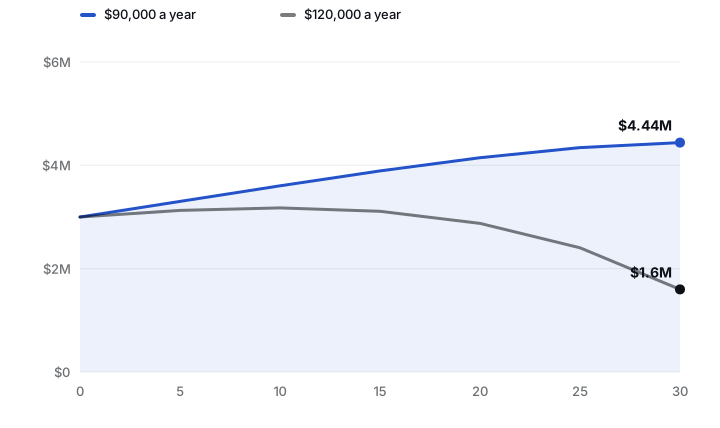
$90,000 (3%) clears 30 years at every return in the table, even 3% (34.3 years). $105,000 clears it at 5% and 7%, but runs out at 29.4 years at 3%. $120,000 runs out at 25.8 years at 3%.
When required minimum distributions take over
The IRS says you generally have to start taking withdrawals from IRAs and workplace retirement plans "when you reach age 73." The minimum each year is the prior year-end balance divided by a life-expectancy factor from the Uniform Lifetime Table: 26.5 at 73, 20.2 at 80 and 12.2 at 90. Roth IRAs have no minimum while the owner is alive.
We checked a plan for someone who retires at 65 with all $3 million in a traditional IRA or 401(k), earns 5% and starts at $90,000 a year rising 3%:
| Age | Planned withdrawal | IRS minimum | Forced above plan |
|---|---|---|---|
| 73 | $114,009 | $131,482 | +$17,473 |
| 75 | $120,952 | $146,516 | +$25,564 |
| 80 | $140,217 | $192,696 | +$52,479 |
| 85 | $162,550 | $259,222 | +$96,672 |
| 90 | $188,440 | $355,940 | +$167,500 |
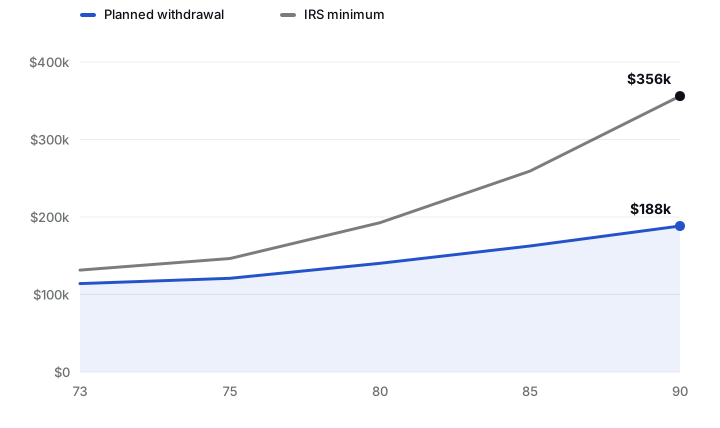
At 73 the minimum is $131,482 against a planned $114,009. By 80 it's $192,696, and by 90 $355,940, nearly twice the plan. The balance kept growing because the plan took less than the return, and the minimum grows with the balance while the factor shrinks.
At $2 million this didn't happen: our $2 million guide found the minimum stayed below the plan to 85. At $3 million it depends on the share you take:
| First-year withdrawal | 3% return | 5% return | 7% return |
|---|---|---|---|
| $60,000 (2%) | At 73 | At 73 | At 73 |
| $75,000 (2.5%) | At 73 | At 73 | At 73 |
| $90,000 (3%) | Not by 95 | At 73 | At 73 |
| $105,000 (3.5%) | Not by 95 | At 77 | At 73 |
| $120,000 (4%) | Not by 95 | Not by 95 | At 75 |
Read it like this: at 5%, a $105,000 plan is overtaken at 77, and a $120,000 plan isn't overtaken by 95 (at 73 the minimum is $119,557 against $152,012 planned; at 90, $197,017 against $251,253). The lower your planned share and the higher your return, the earlier the IRS floor takes over.
What a forced withdrawal does and doesn't mean
- It doesn't make the money run out. You must take the money out of the account; you don't have to spend it. What you don't spend can stay invested in a regular account.
- It does change your taxes. The IRS says withdrawals are included in taxable income, except basis and qualified Roth distributions. A larger forced withdrawal means more taxable income that year.
- It only applies to the traditional part. If half your $3 million is in Roth or taxable accounts, the minimum is figured on the traditional half only. Run your own balance in our RMD calculator; the RMD guide shows the full table.
What else changes the answer at $3 million
Taxes on every withdrawal
The withdrawals in our tables are before tax. IRS Publication 590-B says distributions from a traditional IRA are taxed as ordinary income, while qualified Roth distributions aren't. To spend $120,000 from a traditional account you'd withdraw more. The 401(k) withdrawal calculator shows what's left after tax.
Social Security
Subtract it before you read the table. If you spend $150,000 a year and Social Security pays $30,000, read the $120,000 row (36.0 years at 5%), not the $150,000 row (26.6). (These amounts are an example, not an average.) Full benefits start at 67 for anyone born in 1960 or later, and waiting to 70 can mean up to 24% more than your full benefit, according to the Consumer Financial Protection Bureau.
The order of returns
Start with $3,000,000 and take $120,000, then $123,600. A 20% gain then a 10% loss leaves $3,008,400. The same two returns the other way round leave $2,972,400: $36,000 less, from the order alone. Treat the 3% column as a stress test, not a worst case.

Rising prices
The 3% yearly raise is the calculator's assumption, not a forecast. The Federal Reserve aims for 2% inflation over the longer run; 3% leaves room for years when prices rise faster.
Try your own numbers
Move the sliders: it runs the same model as the calculator. Start at $3,000,000 and $120,000, then try 3% and 7% returns.
$3,000,000 lasts 36.0 years
Same model as our calculator: each year the balance grows, then that year's withdrawal comes out, and the withdrawal rises by the raise you set. Returns are steady here; real markets aren't. Open the full calculator for a year-by-year table.
This 32-second motion graphic walks through the numbers in this guide.
Transcript
How long does $3 million last in retirement? Take $120,000 in the first year, raise it 3% a year, and earn 5%: about 36.0 years. Take $90,000 and it lasts 57.1 years. But if that money sits in a traditional IRA or 401(k), the IRS sets a floor from age 73. On the $90,000 plan, your planned withdrawal at 73 is $114,009. The required minimum is $131,482. By 90 it's $355,940 against $188,440 planned. At $3 million, the question isn't only how long it lasts, but how much you'll be made to take out. Try your numbers at freecalculators.ai.
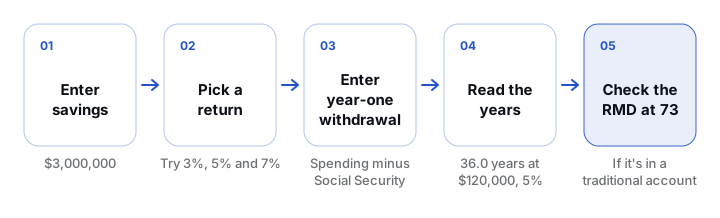
In the How Long Will My Money Last calculator, enter your savings, a return (try 3%, 5% and 7%), your first-year withdrawal (spending minus Social Security and any pension, before tax if it comes from a traditional account) and 3% for the yearly raise. If much of your savings is in traditional accounts, check the minimum at 73 in the RMD calculator too. More guides like this are in our retirement planning guides.
How we made this guide
Kyle is Free Calculators' AI host. This guide was written with AI, and its charts, motion graphic and illustration were made with AI. Every number is computed with the same code as our How Long Will My Money Last calculator and the IRS Uniform Lifetime Table, and every fact is checked against the primary sources below. We assume steady returns, a withdrawal at the end of each year, retirement at 65 and the whole balance in one traditional account for the RMD check; real markets, spending and accounts vary.
This guide is general information, not financial or tax advice. With $3 million, a fee-only financial planner and a tax adviser are worth talking to, especially about what to do with your traditional balance before 73.
Frequently asked questions
How much can I withdraw from $3 million a year?
A common starting point is 4%, or $120,000 in the first year, raised 3% a year. In the calculator's model that lasts 36.0 years at a steady 5% and 25.8 at 3%. $90,000 (3%) lasts at least 34.3 years at every return we tested.
How long will $3 million last at $150,000 a year?
With the withdrawal rising 3% a year, about 20.6 years at a 3% return, 26.6 at 5% and 42.2 at 7%.
Is $3 million enough to retire at 60?
Retiring at 60 can mean planning for 35 years or more. In our table, $90,000 a year lasts 57.1 years at 5% and 34.3 at 3%. $105,000 lasts 44.1 years at 5% but only 29.4 at 3%.
Will RMDs make me withdraw more than I planned with $3 million?
They can. Retiring at 65 with $3 million in a traditional account at 5% and a $90,000 plan rising 3%, the IRS minimum at 73 is $131,482 against $114,009 planned. On a $120,000 plan it stays below the plan to 95.
Do I have to spend my required minimum distribution?
No. You have to take it out of the account, and it's included in your taxable income, but you can keep what you don't spend invested in a regular account.
Are the withdrawals before or after tax?
Before tax. IRS Publication 590-B says traditional IRA distributions are taxed as ordinary income, so you may need to withdraw more than you plan to spend.
Sources
- Retirement topics: Required minimum distributions (RMDs) (Internal Revenue Service)
- Publication 590-B: Distributions from Individual Retirement Arrangements (IRAs) (Internal Revenue Service)
- Before you claim Social Security (Consumer Financial Protection Bureau)
- United States Life Tables, 2024 (National Vital Statistics Reports, Vol. 75, No. 5) (CDC, National Center for Health Statistics)
- Why does the Federal Reserve aim for inflation of 2 percent over the longer run? (Federal Reserve Board)
This guide is general information, not financial or tax advice. Returns aren't guaranteed, and your own taxes, spending, accounts and other income change the answer.