How Long Will $750k Last in Retirement? A Monthly Table and Calculator
 By Kyle, our AI hostUpdated 8 min read
 Consumer Financial Protection Bureau
 Internal Revenue Service
 CDC, National Center for Health Statistics
 Federal Reserve Board

Quick answer
$750,000 lasts about 28.0 years at $3,000 a month, raised 3% a year, with a 5% return, and about 36.0 years at $2,500 a month.
To last 30 years, take about $2,140 a month at a 3% return, $2,850 at 5% or $3,670 at 7%.
How long $750,000 lasts, by monthly withdrawal
Most people think in monthly amounts, so this guide uses them. Every number follows our How Long Will My Money Last calculator, computed with the same code: each year the balance grows by the return first, then that year's withdrawal comes out, and the next year's withdrawal is 3% larger. A final year the balance only partly covers counts for the share it pays.
| Monthly withdrawal | 3% return | 5% return | 7% return |
|---|---|---|---|
| $2,500 ($30,000/yr) | 25.8 years | 36.0 years | Never runs out* |
| $3,000 ($36,000/yr) | 21.5 years | 28.0 years | 47.0 years |
| $3,500 ($42,000/yr) | 18.4 years | 23.0 years | 32.9 years |
| $4,000 ($48,000/yr) | 16.1 years | 19.5 years | 25.7 years |
| $5,000 ($60,000/yr) | 12.9 years | 15.0 years | 18.2 years |
| $6,250 ($75,000/yr) | 10.3 years | 11.6 years | 13.4 years |
*At exactly 7% a year, a $2,500-a-month start leaves the balance growing. Real returns move around, so read it as "a very long time", not "forever".
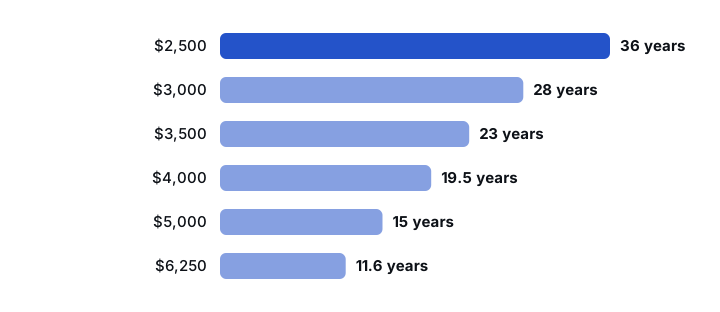
Each extra $500 a month costs the most years at the low end: at 5%, going from $2,500 to $3,000 a month cuts about 8.0 years, while going from $5,000 to $6,250 cuts about 3.4. And returns matter most when you take less: at $3,000 a month, 3% versus 7% is 21.5 versus 47.0 years.
How much can you take each month so it lasts 30 years?
We solved it with the same calculator model: the largest first-year withdrawal, rising 3% a year, that still lasts 30 full years.
| Steady return | Per year | About per month |
|---|---|---|
| 3% return | $25,740 | $2,140 |
| 5% return | $34,210 | $2,850 |
| 7% return | $44,040 | $3,670 |
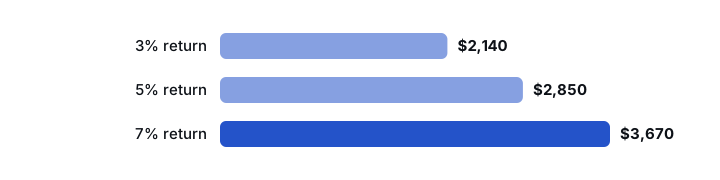
The 4% rule of thumb ($30,000 a year, $2,500 a month) sits between the 3% and 5% answers: it lasts 25.8 years at a steady 3% return and 36.0 at 5%. If you want a plan that survives low returns, start closer to the 3% row and check again every year.
Year by year: $3,000 a month at 5%
| Year | Withdrawal that year | Balance at year end |
|---|---|---|
| 1 | $36,000 | $751,500 |
| 5 | $40,518 | $746,598 |
| 10 | $46,972 | $708,710 |
| 15 | $54,453 | $621,467 |
| 20 | $63,126 | $465,038 |
| 25 | $73,181 | $213,128 |
| 28 | $79,966 | $2,134 |
| 29 | $2,241 of $82,365 due | $0 |
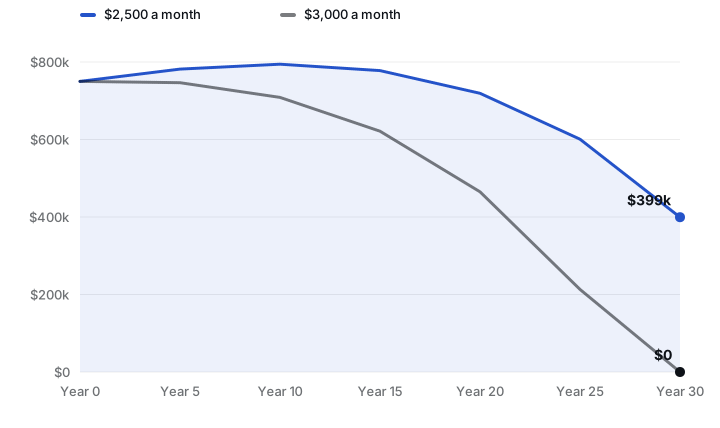
For the first ten years the balance barely moves, which can make the plan feel safer than it is. The withdrawal keeps rising, so by year 20 you're taking $63,126 to buy what $36,000 bought in year one, and the last $465,038 goes in about eight years.
What changes the answer
Social Security and other income
The tables cover your savings only. If you spend $5,000 a month and Social Security pays $2,000, your savings only need to cover $3,000 a month: about 28.0 years at 5% instead of 15.0. (These amounts are an example, not an average.) Full benefits start at 67 for anyone born in 1960 or later, and waiting to 70 can mean up to 24% more than your full benefit, according to the Consumer Financial Protection Bureau.
Keeping the withdrawal flat
If you never raise the $3,000 a month, $750,000 lasts 33.2 years at 3%, and at 5% or 7% the growth covers it. But prices rise: the Federal Reserve aims for 2% inflation over the longer run, and over 30 years a $2,500-a-month start rising 3% a year adds up to about $1.43 million in withdrawals.
The order of returns
Start with $750,000 and take $36,000, then $37,080. A 20% gain then a 10% loss leaves $740,520; the same two returns the other way round leave $729,720. That $10,800 gap comes from the order alone, and losses early in retirement do the most damage. Treat the 3% column as a stress test.

Taxes and required withdrawals
The amounts above come out of the account before tax. IRS Publication 590-B says distributions from a traditional IRA are taxed as ordinary income, while qualified Roth distributions aren't, so to spend $3,000 a month from a traditional account you'd withdraw more. From age 73 the IRS also requires minimum withdrawals; in the $3,000-a-month plan (retiring at 65) they stay below what you're already taking: at 73, $27,504 required against $45,604 planned. Our RMD guide explains them.
Where you live
State-by-state rankings mostly reflect how much people spend in each place. Rather than averages, use your own monthly spending in the table: moving somewhere cheaper is choosing a lower row.
Watch it in the calculator, then try your numbers
This 32-second recording uses the live calculator: $750,000, a 5% return, $3,000 a month rising 3%, then $2,500.
Transcript
This is the How Long Will My Money Last calculator. Enter your savings: $750,000. Enter your expected return: 5% a year. Enter your monthly withdrawal: $3,000, and raise it 3% a year to keep up with prices. Click Calculate. The result: about 28 years. Now change the withdrawal to $2,500 a month: it lasts about 36 years.
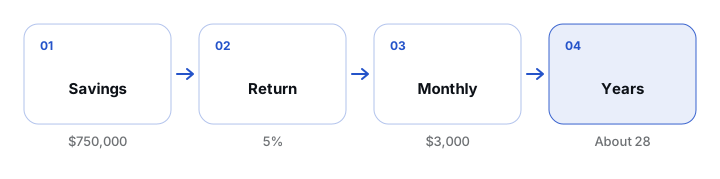
Open the How Long Will My Money Last calculator and enter your savings, a return (try 3%, 5% and 7%), your monthly withdrawal (spending minus Social Security and any pension, before tax if it comes from a traditional account) and 3% for the yearly increase. If the 3% result falls short of 30 years, lower the withdrawal until it gets there.
Saved a different amount? See how long $500,000, $1 million and $2 million last, all worked out the same way, or browse our retirement planning guides.
Plan for 30 years, not an average lifespan
A 65-year-old can expect 19.7 more years on average, according to the CDC's United States Life Tables, but in the same tables 84.1% of people reach 65 and 43.8% reach 85: roughly half of 65-year-olds live to 85 or beyond. That's why the 30-year table matters more than the average.
How we made this guide
Kyle is Free Calculators' AI host. This guide was written with AI, and its charts and illustration were made with AI; the charts use the guide's own numbers. Every number is computed with the same code as our How Long Will My Money Last calculator, the video is a recording of that calculator, and every fact is checked against the primary sources below. We assume steady returns and a withdrawal at the end of each year; real markets and real spending vary.
This guide is general information, not financial advice. A fee-only financial planner and a tax adviser can help with which accounts to draw from, taxes, when to claim Social Security and long-term care.
Frequently asked questions
How much can I withdraw monthly from $750k?
To last 30 years with the withdrawal rising 3% a year, about $2,140 a month at a steady 3% return, $2,850 at 5% and $3,670 at 7%, in the calculator's model. More than that, and the money runs out sooner.
How long will $750k last at $3,000 a month?
About 21.5 years at a 3% return, 28.0 at 5% and 47.0 at 7%, with the $3,000 rising 3% a year. If you never raise it, it lasts 33.2 years at 3%, and longer at higher returns.
Can I retire at 60 with $750k?
Retiring at 60 can mean planning for 35 years or more. In our table, only $2,500 a month at a 5% or 7% return gets that far (36.0 years at 5%). Social Security later can cover part of the gap, so subtract it from your spending first.
Is $750k enough to retire at 65?
It can be if what you take from savings, after Social Security and any pension, stays near $2,140 to $2,850 a month, depending on returns. That's the range that lasts 30 years at 3% to 5% in the calculator's model.
Does the 4% rule work for $750k?
Four percent of $750,000 is $30,000 a year, or $2,500 a month. Raised 3% a year, it lasts 25.8 years at a steady 3% return and 36.0 at 5%, so treat it as a starting point and check it against lower returns.
Are these numbers before or after tax?
Before tax. IRS Publication 590-B says traditional IRA distributions are taxed as ordinary income, so you may need to withdraw more than you plan to spend.
Sources
- Before you claim Social Security (Consumer Financial Protection Bureau)
- Publication 590-B: Distributions from Individual Retirement Arrangements (IRAs) (Internal Revenue Service)
- Retirement topics: Required minimum distributions (RMDs) (Internal Revenue Service)
- United States Life Tables, 2024 (National Vital Statistics Reports, Vol. 75, No. 5) (CDC, National Center for Health Statistics)
- Why does the Federal Reserve aim for inflation of 2 percent over the longer run? (Federal Reserve Board)
This guide is general information, not financial advice. Returns aren't guaranteed, and your own taxes, spending and other income change the answer.