Dividend Yield Calculator
Calculate current and projected dividend yields, income streams, and dividend growth scenarios for income-focused investment strategies
Frequently Asked Questions
What exactly is dividend yield and how is it calculated?
Dividend yield is the annual dividend payment divided by the current share price, expressed as a percentage. For example, if a stock pays $2 in annual dividends and costs $50 per share, the dividend yield is 4%. It's essentially the percentage return you're getting on your investment through dividends alone.
Is a higher dividend yield always better?
Not necessarily! While high yields look attractive, they can sometimes signal trouble. A yield might be high because the share price has fallen (the denominator in the yield equation), possibly due to company problems. Sustainable yields typically range from 2-6% depending on the sector. Anything significantly higher might come with higher risk or limited growth prospects.
How do dividend reinvestment plans (DRIPs) work?
DRIPs automatically use your dividend payments to purchase additional shares of the same stock, often without commission fees. This creates a powerful compounding effect over time. For example, if you start with 100 shares that pay $1 per share annually, you'll receive $100 in dividends. If reinvested at $50 per share, you'd get 2 more shares, which then generate their own dividends, and so on.
What's the difference between dividend growth and dividend yield?
Dividend yield represents your current income relative to your investment (annual dividend/share price), while dividend growth is the rate at which a company increases its dividend payment over time. A stock with a 2% yield but 10% annual dividend growth might eventually provide more income than a stock with a 5% yield but no growth.
How are dividends taxed?
In the U.S., dividends are typically classified as either 'qualified' or 'ordinary.' Qualified dividends are taxed at the more favorable long-term capital gains rates (0%, 15%, or 20% depending on your tax bracket). Ordinary dividends are taxed as regular income. To qualify for the lower rate, you generally need to have held the stock for more than 60 days during a 121-day period that begins 60 days before the ex-dividend date.
What are Dividend Aristocrats and Dividend Kings?
Dividend Aristocrats are S&P 500 companies that have increased their dividend payouts for at least 25 consecutive years. Dividend Kings are even more exclusive - they've raised their dividends for at least 50 straight years. Companies like Coca-Cola, Johnson & Johnson, and Procter & Gamble have maintained this impressive streak, demonstrating exceptional financial stability and commitment to shareholder returns.
Should I focus on dividend stocks or growth stocks?
It depends on your financial goals and time horizon. Dividend stocks typically provide more stable income and can be better for those approaching or in retirement who need regular cash flow. Growth stocks generally reinvest profits back into the business rather than paying dividends, potentially offering higher total returns over longer periods. Many investors benefit from a balanced approach that includes both types of investments.
How can I use this calculator to plan for retirement income?
Start by estimating how much monthly income you'll need in retirement. Then use our calculator's 'Strategies' tab to determine how much you need to invest to reach that income goal. You can adjust variables like initial investment, dividend yield, growth rate, and time horizon to create a realistic plan. The reinvestment feature shows how compounding can accelerate your progress toward your retirement income goals.
Related Calculators
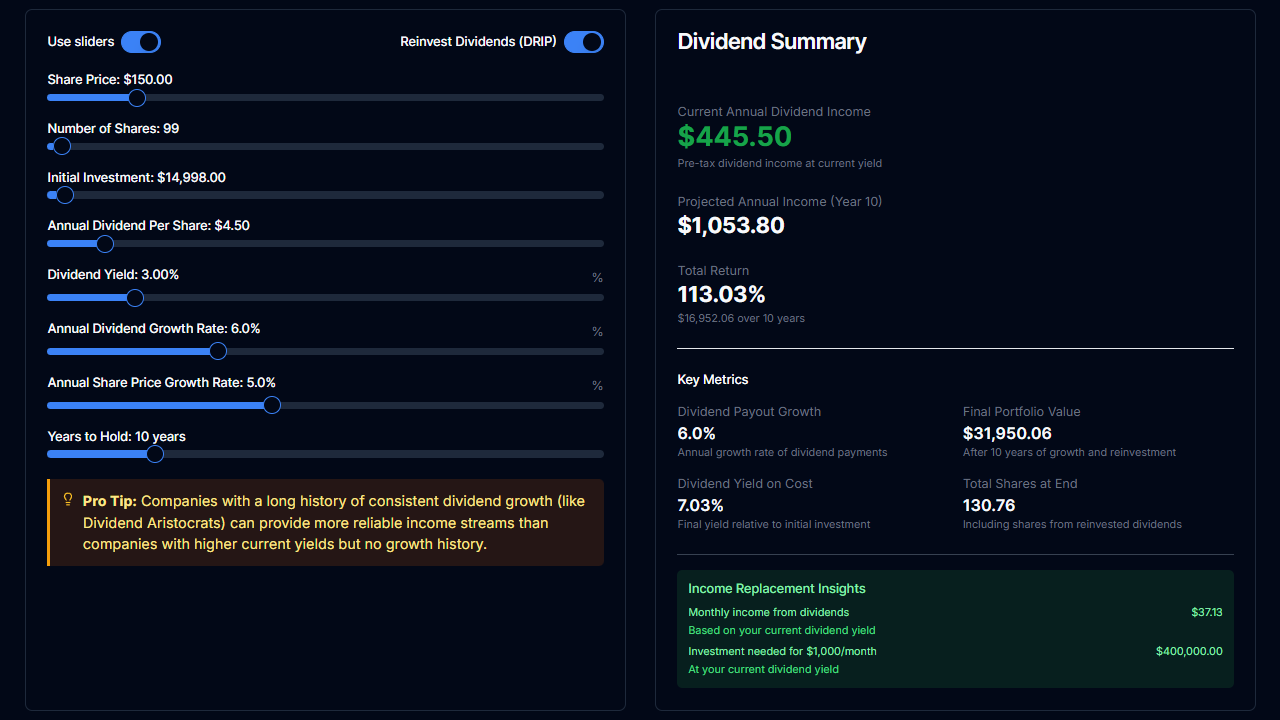
Dividend Yield Calculator in Dark Mode
Calculate dividend income potential with our dark-themed calculator. Analyze income streams.
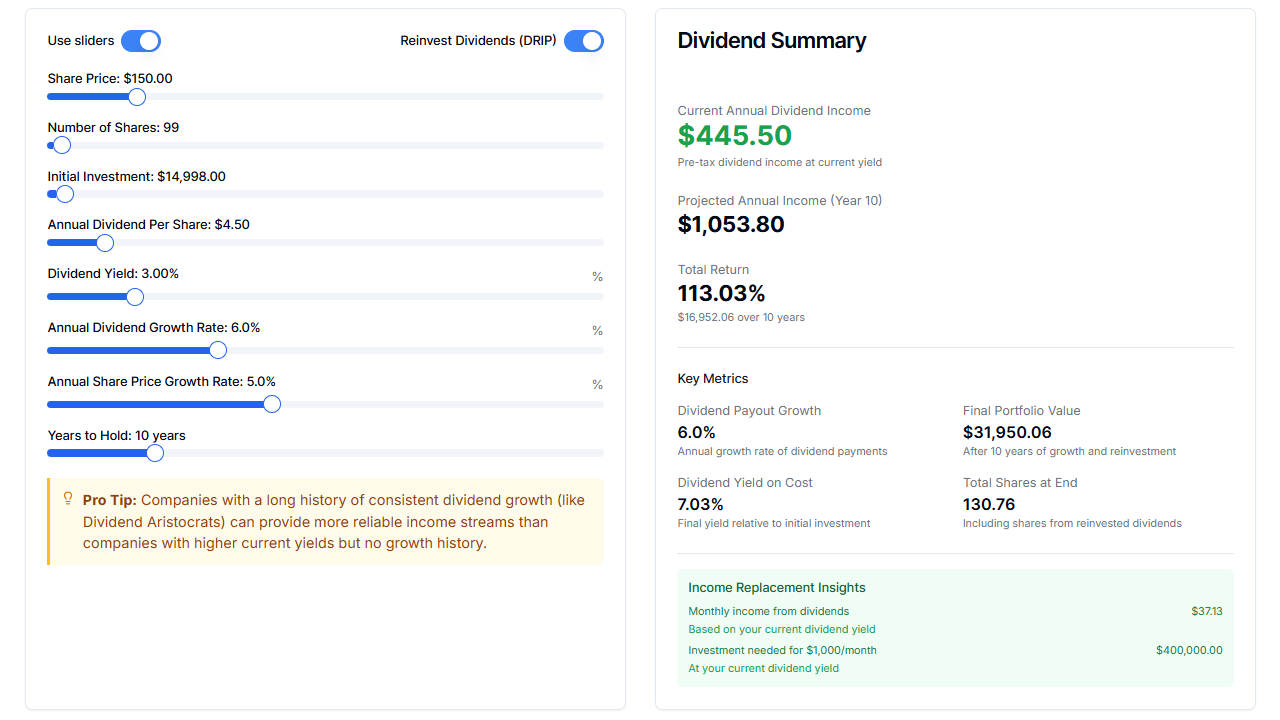
Dividend Yield Calculator in Light Mode
Calculate current and projected dividend yields with our calculator. Plan income-focused investments.