Retirement Withdrawal Calculator
Calculate sustainable withdrawal rates from retirement accounts based on portfolio size, expected returns, inflation, and desired lifestyle
About the Retirement Withdrawal Calculator
Our free retirement withdrawal calculator helps you quickly and accurately perform retirement withdrawal calculations online. This tool is designed to be easy to use and provides instant results without requiring any signup or registration.
How to Use This Calculator
Simply enter your values in the input fields above, and the calculator will automatically process your data and display the results. You can adjust your inputs at any time to see how they affect the outcome.
Why Choose Our Retirement Withdrawal Calculator
- Completely free to use with no hidden fees
- No registration or account creation required
- Accurate calculations based on industry-standard formulas
- User-friendly interface designed for ease of use
- Works on all devices including desktops, tablets, and smartphones
Frequently Asked Questions
What is the 4% rule, and is it still relevant today?
The 4% rule suggests withdrawing 4% of your initial portfolio value in your first year of retirement, then adjusting that amount for inflation each year. While it's a good starting point, many financial experts now suggest a more flexible approach due to today's lower bond yields and higher market valuations. Our calculator allows you to test different withdrawal rates and strategies to find what works best for your situation.
How do I know if my retirement savings will last?
The longevity of your retirement savings depends on several factors: your withdrawal rate, investment returns, inflation, and unexpected expenses. Our calculator helps you visualize how long your money might last under different scenarios. For most retirees, keeping your initial withdrawal rate between 3-5% of your portfolio and maintaining a diversified investment strategy improves the odds of your money lasting 30+ years.
Should I adjust my withdrawals for inflation each year?
Adjusting for inflation helps maintain your purchasing power throughout retirement, which is important for maintaining your lifestyle. However, this approach can put stress on your portfolio during market downturns. Some retirees use a modified approach—adjusting for inflation in good market years but keeping withdrawals flat or reduced during poor market performance. Our calculator lets you see the impact of inflation adjustments on your retirement plan.
What's better: a fixed dollar amount or percentage-based withdrawals?
Each approach has pros and cons. Fixed dollar withdrawals (adjusted for inflation) provide predictable income but don't respond to market conditions. Percentage-based withdrawals automatically adjust to your portfolio value, providing more in good years and less in bad years. This helps preserve your portfolio but creates income volatility. Many retirees find a hybrid approach works best—using guaranteed income sources (Social Security, pensions) to cover essential expenses and percentage-based withdrawals from their portfolio for discretionary spending.
How do Social Security and pensions affect my withdrawal strategy?
Guaranteed income sources like Social Security and pensions create a reliable income floor, allowing you to potentially take more risk or use a higher withdrawal rate with your portfolio. Our calculator lets you include these income sources to see how they affect your overall retirement income plan. Many retirees find they can withdraw a higher percentage from their portfolio when they have substantial guaranteed income covering their basic needs.
What withdrawal strategy works best during market downturns?
Market downturns early in retirement can significantly impact portfolio longevity—a concept called sequence of returns risk. Strategies that help during downturns include: temporarily reducing withdrawals, avoiding selling depreciated assets by keeping 1-2 years of expenses in cash, using a dynamic withdrawal strategy that adjusts based on market performance, or implementing a floor-and-ceiling approach that limits both the downside and upside of your income fluctuations.
How do Required Minimum Distributions (RMDs) affect my withdrawal strategy?
RMDs (currently starting at age 73) require you to withdraw a minimum amount from tax-advantaged retirement accounts like traditional IRAs and 401(k)s. These can complicate your withdrawal strategy if the required amounts exceed what you need or want to withdraw. Our calculator helps you plan for these requirements by showing you how different withdrawal strategies align with potential RMD obligations as you age.
Should I withdraw from tax-deferred or taxable accounts first?
The conventional wisdom is to withdraw from taxable accounts first, then tax-deferred accounts, and finally Roth accounts. This allows tax-advantaged accounts to continue growing tax-free or tax-deferred for longer. However, this isn't always optimal. Some retirees benefit from a more balanced approach that manages their tax bracket each year. Our calculator focuses on the sustainability of your withdrawals, but we recommend consulting with a tax professional for tax-efficient withdrawal sequencing.
How often should I review and adjust my withdrawal strategy?
At minimum, review your withdrawal strategy annually. This allows you to adjust for market performance, inflation, and changes in your spending needs. Many retirees find it helpful to be more flexible in the early years of retirement when their portfolio is most vulnerable to sequence of returns risk. Our calculator makes it easy to run different scenarios as your situation changes, helping you make informed adjustments to your strategy.
Related Calculators
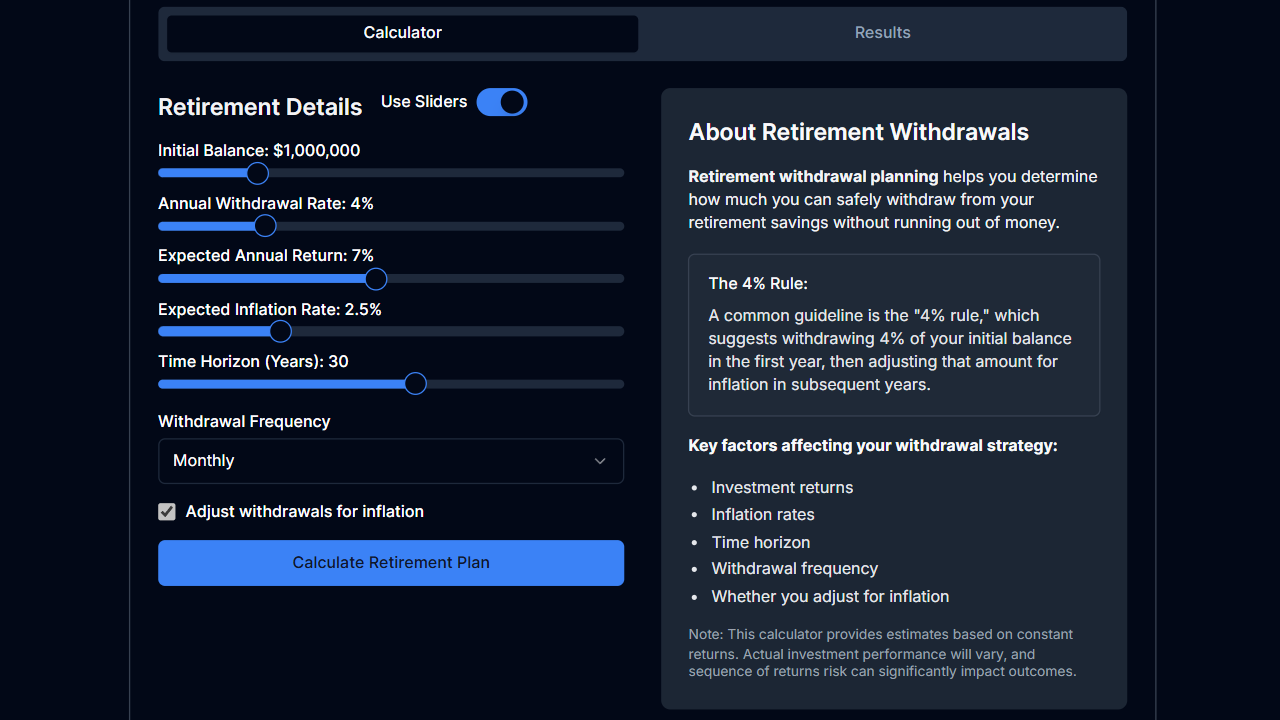
Retirement Withdrawal Calculator in Dark Mode
Plan retirement withdrawals with our dark-themed calculator. Ensure sustainable income throughout retirement.
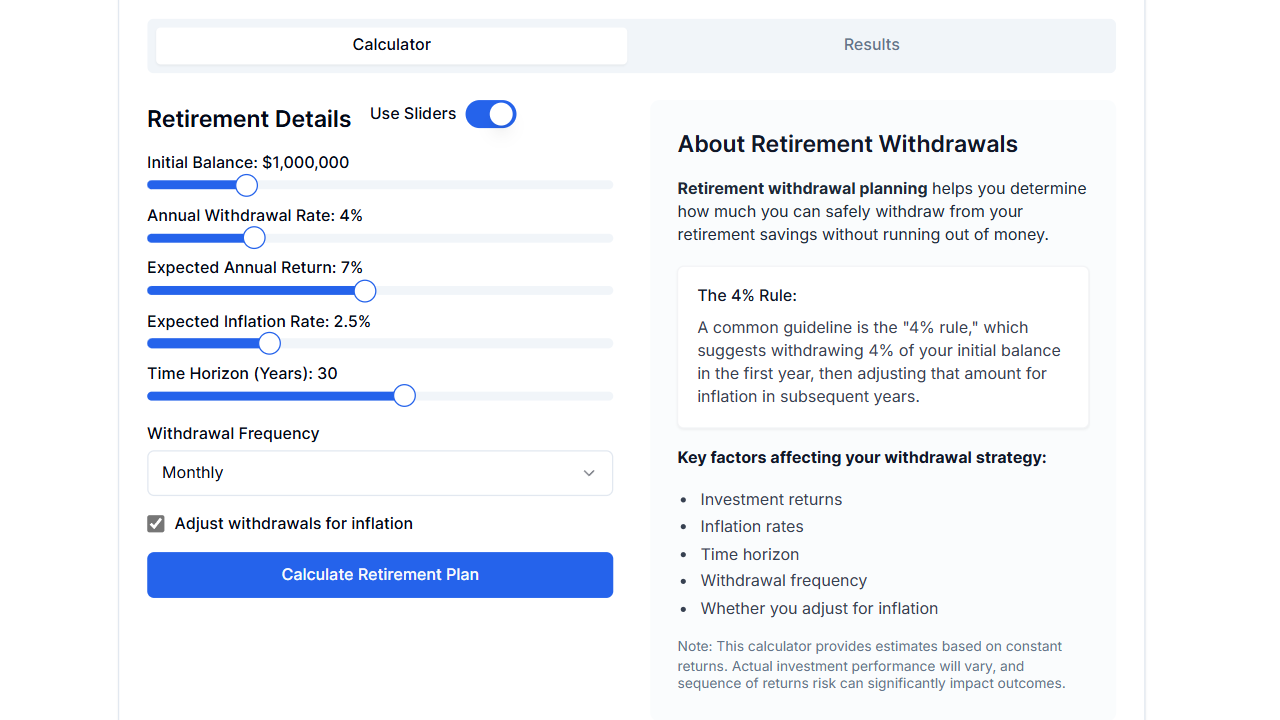
Retirement Withdrawal Calculator in Light Mode
Calculate sustainable retirement withdrawals with our calculator. Plan for a secure and comfortable retirement.