How Much House Can I Afford? A Salary Table, and What Really Moves the Number
 By Kyle, our AI hostUpdated 10 min read
 Consumer Financial Protection Bureau
Quick answer
On a $100,000 salary you can afford about $385,258 of house at a 6.5% rate with 20% down and no other debts, using the common 28/36 rule. That's about 3.9 times your income.
Each one-point change in the rate moves it by about 8–9%. Other debts and a down payment under 20% change it more than most people expect.
The rule lenders' numbers start from: 28/36
Your debt-to-income ratio is "all your monthly debt payments divided by your gross monthly income," as the Consumer Financial Protection Bureau puts it, and "different loan products and lenders will have different DTI limits." A common rule of thumb, and the one our Mortgage calculator uses, has two limits:
- 28% for housing: principal, interest, property tax, insurance and any mortgage insurance.
- 36% for housing plus every other debt payment: car loans, student loans, card minimums.
Lenders don't just apply a formula, either: "A lender must make a good-faith effort to determine that you have the ability to repay your mortgage before giving it to you," the CFPB says. Treat 28/36 as the starting point for that conversation.
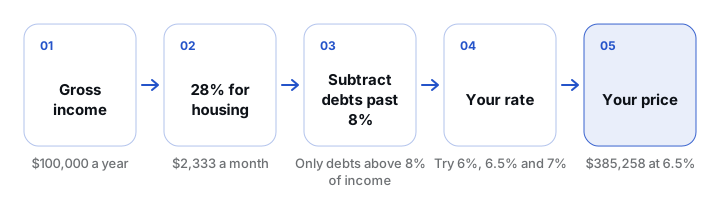
On $100,000 a year that's a housing budget of $2,333 a month. The question is how much house that budget buys, and it depends on the rate, your down payment and your other debts.
How much house you can afford, by salary and rate
Every price below uses the Mortgage calculator's payment formula: a 30-year fixed loan, 20% down, and property tax and insurance at the calculator's defaults ($3,000 and $1,200 a year on a $350,000 home, scaled to the price). No other debts.
| Gross salary | 5.5% | 6% | 6.5% | 7% | 7.5% |
|---|---|---|---|---|---|
| $50,000 | $211k | $201k | $193k | $185k | $177k |
| $75,000 | $316k | $302k | $289k | $277k | $265k |
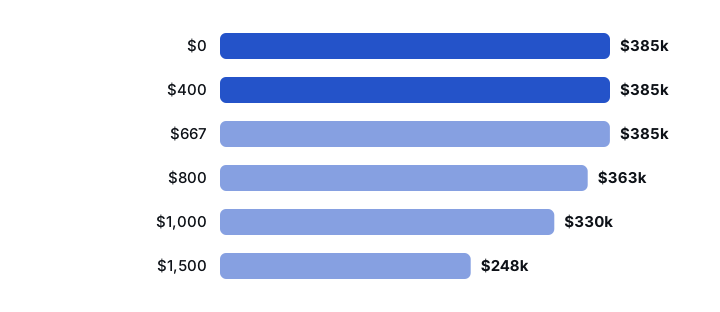
| $100,000 | $421k | $403k | $385k | $369k | $354k |
| $125,000 | $526k | $503k | $482k | $461k | $442k |
| $150,000 | $632k | $604k | $578k | $554k | $531k |
| $200,000 | $842k | $805k | $771k | $738k | $708k |
We show a range of rates because offers vary. In the CFPB's own example for a $400,000 home with 10% down and a 700 credit score, "loan offers could range from 5.875% to 8.125%." Find your row, then your rate.
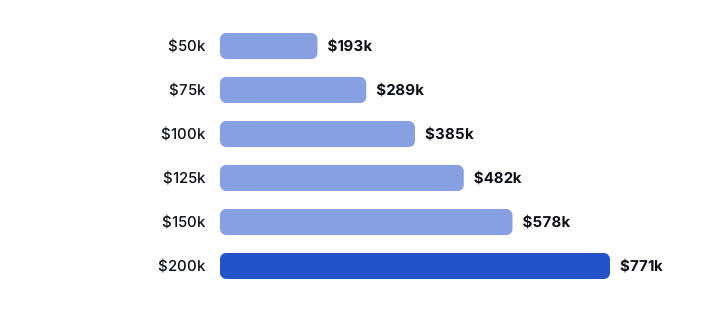
- It scales with income. Double the salary, double the house: about 3.9× income at 6.5%.
- A rate point is worth about 8–9% of the price. On $100,000, 6.5% buys $385,258; 7% buys $369,057.
- "Three times your income" is too cautious at these rates for someone with no other debts and 20% down, and too generous for someone with large debts or a small down payment, as the next two sections show.
Your other debts: free up to a point, then expensive
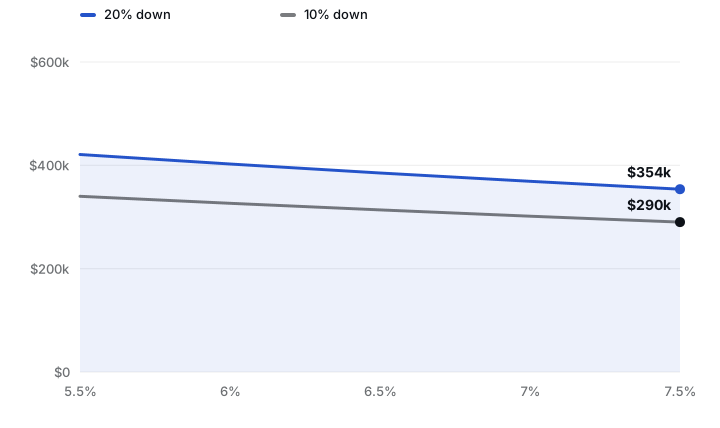
Here's what most affordability calculators don't show. Because the total-debt limit (36%) is 8 points above the housing limit (28%), your first debts cost you nothing: up to 8% of your gross income, about $667 a month on $100,000, they fit in the gap. Past that, every dollar of debt comes out of the housing budget.
| Other monthly debts | Home price | What sets the limit |
|---|---|---|
| $0 | $385k | Housing (28%) |
| $400 | $385k | Housing (28%) |
| $666 | $385k | Housing (28%) |
| $800 | $363k | Your debts (36%) |
| $1,000 | $330k | Your debts (36%) |
| $1,500 | $248k | Your debts (36%) |
Past the free allowance, each $100 a month of other debt costs about $16,511 of house. Paying off a $400-a-month car loan before you apply changes nothing if it's your only debt, and a lot if it's on top of student loans.
Down payment: the 20% cliff
The CFPB explains that private mortgage insurance (PMI) is something you "might be required to buy if you take out a conventional loan with a down payment of less than 20 percent of the purchase price." The Mortgage calculator adds it at 1% of the loan a year below 20% down. That makes 20% a cliff:
| Down payment | Home price | Cash needed | PMI |
|---|---|---|---|
| 5% | $299k | $14,964 | Yes |
| 10% | $314k | $31,368 | Yes |
| 15% | $330k | $49,429 | Yes |
| 20% | $385k | $77,052 | No |
| 25% | $406k | $101,617 | No |
Going from 20% down to 15% doesn't just add a bigger loan: PMI starts, and the price you can afford drops by about $55,734. Real PMI rates vary with your credit and the loan, so ask a lender for a quote; the shape of the cliff is the point.
What else changes the answer
- Your credit score. The CFPB notes that "applying with a higher credit score means you generally are offered more affordable loans (that is, lower interest rates)." Lower rate, more house.
- Where you live. Our tax and insurance figures are the calculator's defaults. High-tax areas, flood or wind cover and HOA dues all come out of the same 28%.
- Cash beyond the down payment. Closing costs and a cushion for repairs aren't in the table. The price you can afford monthly isn't the price you can afford in cash.
- Gross, not take-home. The rule uses income before tax. If your take-home pay is low for your gross (high taxes, retirement savings), you may want to aim below the table.
Try your own numbers
Move the sliders: it runs the same model as the tables above.
About $385,258 of house
A $2,333 monthly housing budget, set by the 28% housing limit. Down payment: $77,052.
Tax and insurance use the calculator's defaults scaled to price; PMI is 1% of the loan a year under 20% down. For a full payment with your own tax, insurance and HOA, use the Mortgage calculator.
This 32-second motion graphic walks through the numbers.
Transcript
How much house can you afford? On $100,000 a year, the 28% rule gives a housing budget of $2,333 a month. At a 6.5% rate, with 20% down, that buys about $385,258 of house: 3.9 times your income. At 7%, it's $369,057. Other debts don't change it until they pass about $667 a month; after that, each $100 a month costs about $16,511 of house. And dropping from 20% down to 15% costs about $55,734, because mortgage insurance starts. Try your numbers at freecalculators.ai.
For a full monthly payment with your own property tax, insurance, HOA and extra payments, use the Mortgage calculator. A first-year principal-and-interest payment on a $385,258 home with 20% down at 6.5% is $1,948 a month.
How we made this guide, and when to ask a professional
Kyle is Free Calculators' AI host. This guide was written with AI, and its charts, motion graphic and illustration were made with AI. Every number is computed with the Mortgage calculator's own payment formula; facts come from the Consumer Financial Protection Bureau pages below. The 28/36 rule is a rule of thumb, not a lender's decision.
This is general information, not financial advice. A lender's pre-approval tells you what you can borrow; a HUD-approved housing counselor or a fee-only planner can help you decide what you should.
Frequently asked questions
How much house can I afford on $100,000 a year?
About $385,258 at a 6.5% rate with 20% down and no other debts, using the 28/36 rule and the Mortgage calculator's tax and insurance defaults. At 7% it's about $369,057.
How much house can I afford on $50,000 a year?
About $192,629 at 6.5% with 20% down and no other debts, and about $184,528 at 7%.
What is the 28/36 rule?
A rule of thumb: spend at most 28% of gross monthly income on housing (principal, interest, tax, insurance and any mortgage insurance) and at most 36% on housing plus all other debt payments. Lenders set their own limits, and the CFPB notes they differ by loan product and lender.
Is three times your salary a good rule?
At 6.5% with 20% down and no other debts, the 28% rule allows about 3.9 times income, so three times is cautious. With large debts or a small down payment, three times can be too much.
Do car loans and student loans reduce how much house I can afford?
Only past a point. Under 28/36, other debts up to 8% of gross income fit in the gap between the two limits. Beyond that, each $100 a month of debt cuts about $16,511 from the price on a $100,000 salary at 6.5%.
Does putting less than 20% down change how much I can afford?
Yes, sharply. Below 20% down on a conventional loan you may have to pay private mortgage insurance, and in the calculator's model the price a $100,000 salary affords at 6.5% drops by about $55,734 at 15% down.
Sources
- What is a debt-to-income ratio? (Consumer Financial Protection Bureau)
- What is private mortgage insurance? (Consumer Financial Protection Bureau)
- Explore interest rates (Consumer Financial Protection Bureau)
- What is a Qualified Mortgage? (Consumer Financial Protection Bureau)
This guide is general information, not financial advice. Rates, taxes, insurance and lender limits vary, and a lender's pre-approval is the real answer.